If you missed the February 1 deadline for California’s new SB 294 notice requirement, you’re not alone. Many ministries are just now learning about the Workplace Know Your Rights Act, and the good news is that getting compliant is straightforward. The not-so-good news: using the wrong template could create a bigger problem than missing the deadline altogether.
SB 294 in California requires every employer to provide employees a written notice about their workplace rights. That includes your church, school, camp, or mission organization. But the state’s generic template includes language about the right to unionize and references the National Labor Relations Board, which religious organizations are legally exempt from. Handing that version to your staff could actually waive protections you didn’t know you had.
In this article, we’ll cover exactly what SB 294 requires, what your notice must include, why the state template is risky for ministries, and a simple action checklist you can work through today.
Does This Apply to Us?
Short answer: yes. SB 294 applies to every California employer regardless of size. There is no minimum employee threshold and no religious organization exemption from the notice requirement itself. If your organization is based out of state but has even one employee physically working in California, you are covered.
What SB 294 Requires
The Workplace Know Your Rights Act established three ongoing obligations:
- **Notice to current employees **was due by February 1, 2026
- **Notice to new hires **must be provided at the time of hire
- **Annual notice **must be redistributed to all employees every year going forward
This isn’t a one-time posting. The California Labor Commissioner will update the notice content annually, which means you’ll need to redistribute a current version each year.
What the Notice Must Include
Your written notice needs to cover six specific areas:
- Workers’ compensation benefits, including temporary disability pay and medical care for work-related injuries, along with contact information for the CA Division of Workers’ Compensation
- Protection against unfair immigration-related practices
- Constitutional rights when interacting with law enforcement, specifically the Fourth Amendment (protection from unreasonable search and seizure) and Fifth Amendment (right to remain silent)
- Right to organize or engage in concerted workplace activity
- **A list of enforcement agencies **developed by the Labor Commissioner
- **A link to the Labor Commissioner’s video **once it becomes available (expected July 1, 2026)
The notice must also inform employees of their right to designate an emergency contact in the event of arrest or detention while at work or on a work site. Employees aren’t required to complete the designation, but you are required to offer it.
Why Ministries Should NOT Use the State Template
The CA Labor Commissioner published a template notice that employers “may use” to comply. But that template includes language about the right to unionize and provides NLRB contact information. Here’s the problem: religious nonprofits are not subject to the National Labor Relations Board. This was affirmed in the Bethany College decision in 2020, which confirmed that the NLRB does not have jurisdiction over religious organizations.
When a ministry hands employees a notice that highlights who to contact to unionize, it can unintentionally create a paper trail suggesting the organization has recognized NLRB authority. Employment attorneys look for exactly this kind of evidence, and it can even trigger an NLRB investigation, which your organization should never have been subject to in the first place.
This risk also applies to secular HR resources that reference the NLRB, including notices automatically sent by some payroll providers. If your payroll system has already distributed the standard state template, it’s worth reviewing and correcting.
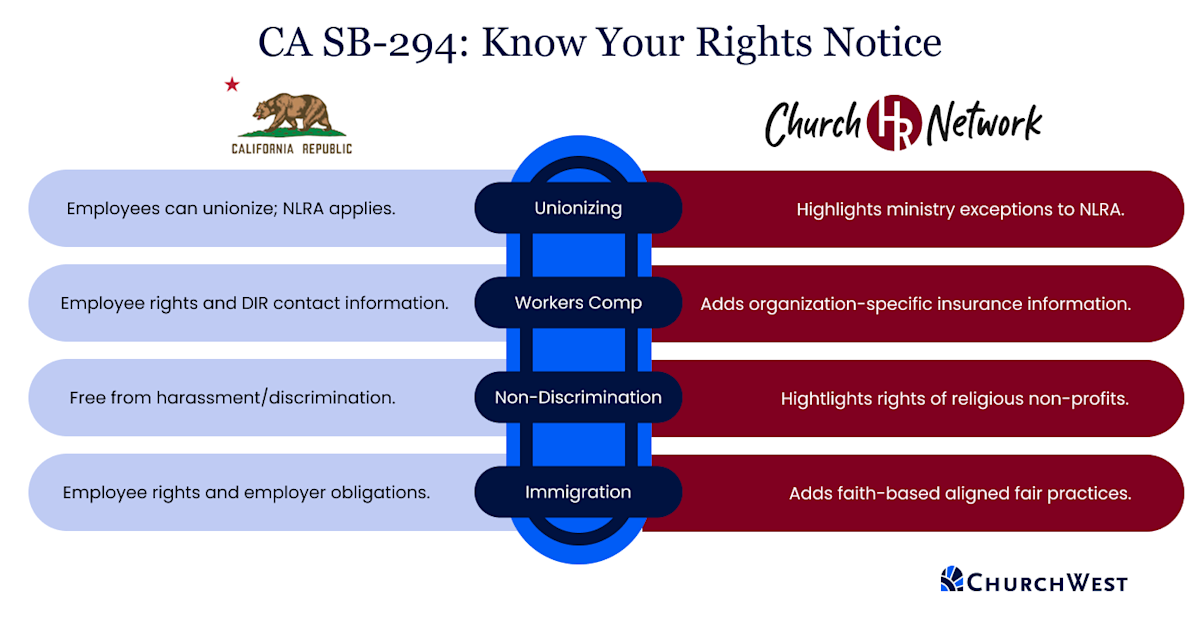
The solution is straightforward: use a ministry-specific notice that includes all six required elements while correctly reflecting the NLRB exemption for religious organizations. ChurchWest and Church HR Network have created exactly that, free to download.
Record-Keeping and What to Do If Someone Won’t Sign
You’re required to keep proof that each employee received the notice for three years. That means documenting the date and method of delivery for every person on your team.
If an employee refuses to sign, that’s their right. The law requires you to provide the notice, not to obtain a signature. Write “refused to sign” on the form with the date and your name, then file it. Electronic signatures are acceptable for those who do sign.
Save your sent emails. Keep copies of signed forms. Put everything in the employee’s personnel file alongside the emergency contact designation form.
Update Your Employee Handbook This Year
The standalone SB 294 notice does not replace your handbook policies. Leslie DeMattia, President of Church HR Network, recommends that you also update your employee handbook with two additions:
- A workers’ compensation policy that covers how to file a claim, what to expect during the process, and how to report a workplace injury. (If you need workers’ comp coverage itself, that’s a conversation worth having.)
- A non-retaliation policy that explicitly addresses SB 294. The new law makes it illegal to discharge, demote, suspend, or retaliate against any employee for exercising their rights under this act. That primarily covers workers’ comp claims, exercise of constitutional rights, and having an emergency contact notified.
Having both the standalone notice and the handbook policies creates layered documentation. If you ever end up in an employment dispute, that evidence shows you did your job and did it well.
Your Action Checklist
If you haven’t issued the notice yet, here’s what to do today:
- Download the ministry-specific Know Your Rights notice (free, from Church HR Network and ChurchWest)
- Replace the Church HR Network logo with your ministry’s logo
- Distribute to all current employees and collect signatures (don’t backdate)
- Set up your process for distributing the notice to every new hire going forward
- File signed copies (or refusal documentation) in each employee’s personnel file
- Request a ministry-specific labor poster if you haven’t updated yours recently
- Schedule your annual redistribution (add a December calendar reminder to check for updates)
- Update your employee handbook with workers’ comp and non-retaliation policies
- Watch for the Labor Commissioner’s video release in July 2026
For a deeper walkthrough, watch the full SB 294 webinar recording with Church HR Network.
What Happens If You Don’t Comply
Non-compliance can result in fines from the California Department of Labor or a local prosecutor. But the larger practical risk is in employment disputes. Plaintiff’s attorneys now have SB 294 compliance on their discovery checklist. If a former employee files a claim and you can’t show you provided this notice, it becomes one more piece of evidence that weakens your position.
The fix is simple and free. There’s no reason to leave this undone.
ChurchWest has served California ministries for over 50 years, supporting more than 4,400 churches, schools, and faith-based organizations. For ministry-specific compliance guidance or to connect with a California insurance specialist, get in touch.
This article is for informational purposes only and does not constitute legal advice. Consult an attorney for guidance specific to your organization.
Conclusion
This post was created by the team at ChurchWest to help ministry leaders navigate complex decisions with clarity and care. If you want to explore more resources or talk with our specialists, we are here to help.